7 Mistakes to Avoid When Switching to a SEOWriting AI Alternative
Switching from SEOWriting sounds simple until your first batch of drafts comes back unusable. Many platforms hide their content modes, credit rules, and publishing limits behind a pricing page, and you only discover the gaps after you have paid. That is where the second migration becomes expensive.
This article walks through seven mistakes to avoid, from skipping content modes and SERP analysis to ignoring rollover terms, integrations, and support. By the end, you will know how to compare Autoblogging.ai against your current setup and decide whether the switch actually fits your workflow.
What Is Autoblogging.ai? A Quick Definition
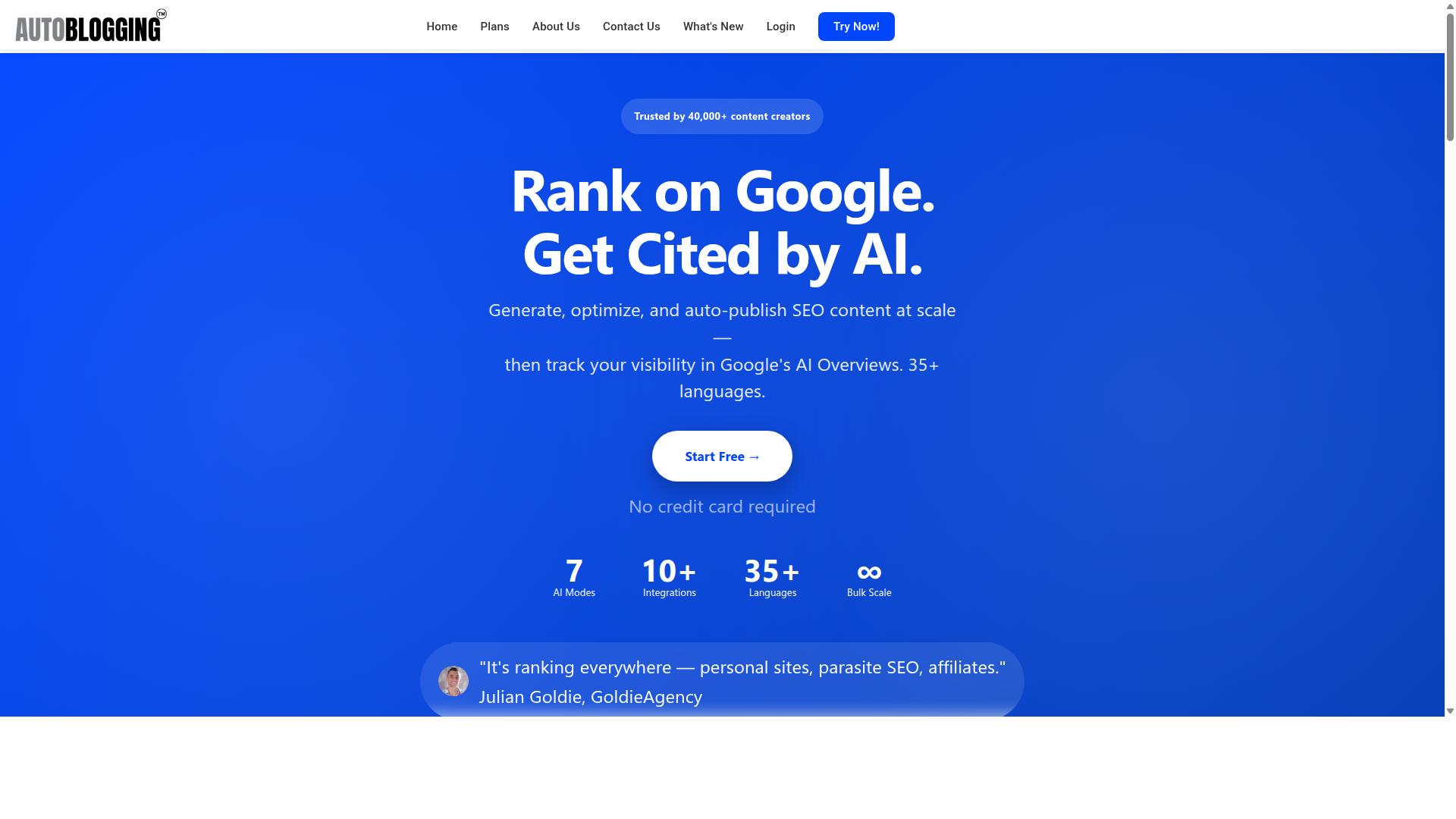
Autoblogging.ai is an AI-powered article generation platform that creates SEO-optimized content using advanced language models and competitor analysis. It is built for people who need to publish consistently without spending hours writing every draft by hand.
The platform is a product of Digimetriq.com, founded in 2022 by Vaibhav Sharda. Its stated mission is to help bloggers, website owners, and agencies save time and improve their online presence through cutting-edge technology.
That mission has two layers worth understanding. Autoblogging.ai is designed to cut down content costs and give the power to human counterparts within existing standard operating procedures by producing the first draft. Digimetriq, the company behind it, aims to replace human counterparts entirely.
In plain terms, the tool sits at the draft stage of the content workflow. Instead of facing a blank page, a user starts with AI-generated content that already reflects SEO considerations, then refines it. For anyone weighing a SEOWriting AI alternative, this distinction matters: the question is not whether AI writes the first pass, but how well the tool fits the rest of your content creation process.
This high-level definition is the foundation for the mistakes covered in this article. Many switching errors come from misunderstanding what an AI writing tool is meant to do, and what still requires human judgment.
Who It Serves: Bloggers, Agencies, and SEO Professionals
Autoblogging.ai is designed for a diverse range of users, including bloggers, website owners, SEO professionals, marketing agencies, content creators, and affiliate marketers. Each group has a different reason for adopting an AI writing tool.
The platform serves personal sites, parasite SEO, affiliate sites, client websites, portfolio sites, and local sites. That range says a lot: the same core capability has to support a solo blogger publishing on their own domain and an agency juggling multiple client properties.
For bloggers and website owners, the appeal is straightforward. Producing content at volume takes time, and an AI article generator reduces the hours spent on first drafts so effort can go toward editing, promotion, and content strategy.
For marketing agencies, the value shifts toward scalability and client management. When you serve several client websites at once, a repeatable drafting process helps keep output steady across accounts without proportionally growing the writing workload.
For SEO professionals and affiliate marketers, the focus lands on optimization. These users care about keyword optimization, matching search intent, and structuring content so it can compete in search results.
- Bloggers and content creators: save time and maintain publishing volume on personal sites
- Marketing agencies: scale output across client websites and portfolio sites
- SEO professionals and affiliate marketers: produce optimized drafts for affiliate sites, parasite SEO, and local sites
Understanding which group you belong to is useful before switching tools. A feature that matters to an agency managing ten client websites may be irrelevant to a solo blogger running one affiliate site, and vice versa.
Why People Switch Away from SEOWriting - and Where Autoblogging.ai Fits
Users often switch from SEOWriting due to limitations in content modes, output quality, or pricing flexibility, and Autoblogging.ai offers a compelling alternative with its advanced features and transparent pricing. The reasons behind these migrations tend to follow a few predictable patterns, and understanding them helps anyone planning a SEOWriting AI alternative make a smarter decision.
The most common frustration is a narrow set of writing modes. When an AI writing tool offers only a handful of output styles, every article starts to feel the same. Teams producing SEO content at scale need variety, from long-form blog posts to product descriptions, and a limited mode selection forces manual rewriting that eats into time savings.
Quality control is the second big driver. Writers often report that AI-generated content needs heavy editing before publishing, which defeats part of the purpose of automation. Without built-in checks for readability, keyword optimization, and structure, the burden shifts back to the editor.
Pricing structure rounds out the top three. Credit systems that expire at the end of each billing cycle punish inconsistent usage. A freelancer with a slow month loses paid credits, and an agency with a busy month runs out mid-project. Both scenarios push users to look for a more forgiving model.
Autoblogging.ai addresses these pain points directly. It is a content creation platform trusted by 40,000+ content creators, with 1M+ articles generated and a 4.9 average rating. Its feature set maps closely to what switchers say they were missing.
- 10+ AI modes for different content types and formats, compared to a limited mode selection elsewhere
- 35+ languages for multilingual campaigns and international audience targeting
- Credits rollover, so unused credits carry forward instead of expiring
- 24/7 support for help at any hour or timezone
- Human proofreader included in all plans for an extra layer of content quality control
- One-click WordPress publish to shorten the path from draft to live page
Beyond the core modes, Autoblogging.ai includes SERP competitor analysis and semantic SEO tools, a 21-point SEO audit, and featured snippet optimization. These features speak to keyword optimization and search intent, two areas where thin AI-generated content tends to struggle.
The platform also offers 35+ integrations and ships new features weekly, which matters for teams building a long-term content strategy. Stagnant tools force workarounds. Actively developed ones absorb new SEO requirements as search engines evolve.
For anyone weighing a switch, the pattern is clear. The decision usually comes down to whether the new tool offers more modes, stronger quality safeguards, and fairer credit terms. Autoblogging.ai checks all three boxes while adding language coverage and publishing conveniences that reduce friction across an entire editorial calendar.
Mistake 1: Choosing an Alternative Without Checking Its Content Modes
Many users overlook the importance of content modes when selecting an AI writing tool, only to find that the tool lacks the flexibility needed for different content types. Content modes are not a cosmetic feature. They determine the quality, style, and suitability of generated content for various purposes.
A tool built around a single generation style tends to produce generic or off-target articles. A news piece needs timeliness and a different structure than a product review. A pillar page needs depth and semantic coverage that a quick draft cannot deliver. When the tool has no mode for the job, the writer ends up fixing output by hand.
Before committing to any SEOWriting AI alternative, check what modes it actually offers. Ask three questions:
- Does it separate fast drafting from in-depth optimization?
- Can it handle niche formats like product reviews or current events?
- Does it support scaling when you need many articles, not just one?
Autoblogging.ai is a useful benchmark here because its modes map directly to distinct content jobs. The platform pairs its article generation modes with optimization tools such as Site Optimizer, Semantic SEO Analysis, Snippet Optimizer, Topical Maps, and an AI Proofreader. That combination matters for content quality and for meeting expectations around E-E-A-T.
A tool without diverse modes forces you into a single workflow. You then risk keyword stuffing, weak readability, and content that misses search intent. Checking modes first is the simplest way to avoid that trap.
Quick Mode, Godlike Mode, Bulk Generation, News Mode, and Amazon Reviews Mode
Autoblogging.ai offers a range of content modes tailored to different needs: Quick Mode for fast drafts, Godlike Mode for in-depth SEO optimization, Bulk Generation for scaling content, News Mode for timely articles, and Amazon Reviews Mode for product-focused content. Each one fits a different stage of a content strategy.
Quick Mode is free and available in single and wizard formats. It suits early drafts, topic exploration, and situations where speed matters more than polish. Use it when you want a starting point to edit, not a finished asset.
Godlike Mode goes much deeper. It performs SERP competitor analysis, LSI keywords work, and knowledge graph extraction. This is the mode for pillar pages, topic clusters, and pages where keyword optimization and semantic coverage drive search engine ranking. The LSI and knowledge graph elements help you avoid thin content and over-optimization at the same time.
Bulk Generation produces up to 500 articles via CSV. It fits editorial calendars and sites that need consistent publishing volume without drafting every piece by hand. Pair it with a human proofreader so tone consistency and brand voice hold across the batch.
News Mode integrates with Google News. It targets current events, where content freshness and timeliness decide whether a piece ranks or gets buried. Use it for timely coverage, not evergreen guides.
Amazon Reviews Mode handles product-focused content for affiliate workflows. It fits review pages and buying guides where audience targeting and search intent are commercial rather than informational.
Matching the mode to the job protects readability and user experience. It also reduces the risk of duplicate content and plagiarism flags that come from forcing one style onto every format. A tool that covers all five of these jobs gives you room to build a real content strategy instead of a single repeated template.
Mistake 2: Ignoring Output Quality Controls Like SERP Analysis and Human Proofreading
Overlooking output quality controls can lead to poorly optimized content that fails to rank, making features like SERP analysis and human proofreading essential for success. When you switch to a SEOWriting AI alternative, it is tempting to publish whatever the tool generates and move on to the next task.
That shortcut usually backfires. AI-generated content can read smoothly while still missing the mark on search intent, competitor coverage, and brand voice. Quality controls close that gap before publishing, not after rankings stall.
SERP analysis is the first control worth demanding. It means studying what already ranks for your target keyword, then shaping your draft to match the depth, structure, and angle those pages deliver. Without it, an AI writing tool may produce technically clean copy that answers a different question than the one searchers are asking.
The second control is human proofreading. Even strong AI output can drift in tone, repeat phrases, or misstate a nuance that matters to your audience. A human pass protects content quality, readability, and the consistency readers expect from your brand.
Autoblogging.ai builds both controls into its platform rather than treating them as afterthoughts:
- Godlike Mode includes SERP competitor analysis, LSI keywords, and knowledge graph extraction
- Semantic SEO Analysis with a 21-point audit for keyword optimization
- AI Proofreader and Human Proofreader for catching issues before publication
- Snippet Optimizer and Topical Maps to strengthen structure and coverage
This combination matters because search engine ranking rewards content that satisfies intent, not just content that exists. Skipping SERP analysis often leads to keyword stuffing or over-optimization, while skipping proofreading invites tone inconsistency and readability problems that hurt user experience.
If you are evaluating a SEOWriting AI alternative, check whether quality controls are native to the tool or something you must bolt on later. Autoblogging.ai treats them as core features, which makes it easier to maintain a repeatable content strategy instead of gambling on every draft.
Mistake 3: Overlooking Pricing, Credits, and Rollover Terms
Failing to scrutinize pricing structures, credit systems, and rollover policies can result in unexpected costs or insufficient content generation capacity. Many users switch to a SEOWriting AI alternative focused only on the headline monthly price, then discover the real cost once they start producing content at scale.
Pricing models across AI writing tools vary widely. Some charge per seat, others per word, and many rely on a credit system where each article or keyword optimization task consumes a set number of credits. The trouble starts when those credits expire at the end of each billing cycle. If you generate less content in a slow month, that unused capacity simply disappears.
This creates a budgeting trap. A plan that looks affordable on paper can force you to buy top-up credits during busy periods, while the credits you already paid for go to waste during quiet ones. For anyone building a long-term content strategy, that inconsistency makes planning difficult.
Rollover terms deserve just as much attention as the sticker price. A tool with credit rollover lets unused credits carry forward, so a light month does not mean lost value. Without rollover, your effective cost per article rises whenever production dips. Before committing to any AI writing tool, check three things:
- Whether unused credits expire or carry over
- How many credits a typical article or keyword optimization task consumes
- Whether additional credits can be purchased when demand spikes
Autoblogging.ai takes a different approach. Its transparent pricing is published openly, and every plan includes credits rollover, so unused capacity is never wasted. That single policy removes much of the guesswork from budgeting for AI-generated content.
Monthly and Annual Plans from $19 to $999
Autoblogging.ai offers flexible monthly and annual plans ranging from $19 for 40 credits to $999 for 5,000 credits, catering to users from hobby bloggers to large agencies. The structure is straightforward, with no hidden tiers or surprise fees.
Monthly plans are priced as follows:
- Starter: $19 for 40 credits
- Regular: $49 for 120 credits
- Standard: $99 for 300 credits
- Gold: $179 for 600 credits
- Premium: $249 for 1,000 credits
- Enterprise: $999 for 5,000 credits
Annual plans offer a discount for users who commit to a full year. Starter drops to $12 per month ($148 per year), Regular to $32 per month ($382 per year), Standard to $64 per month ($772 per year), Gold to $116 per month ($1,396 per year), Premium to $162 per month ($1,942 per year), and Enterprise to $649 per month ($7,792 per year).
The key differentiator is that credits roll over on every plan, unlike some competitors where unused credits vanish at renewal. New accounts also receive 10 free credits per month with no credit card required, which lets users evaluate content quality before paying. Additional credits can be purchased whenever demand rises, and payments are accepted via Visa, MasterCard, American Express, and PayPal, with bank transfers available for annual enterprise plans through Stripe. Cancellation is available at any time.
For teams that prefer a hands-off route, Done For You packages are also available: Starter at $1,200 for 1,000 articles, Pro at $1,600, Corp at $4,000, and Senpai at $10,000, each covering 1,000 articles. Whether you are a solo blogger or an agency managing multiple client sites, the combination of published rates and rollover credits makes Autoblogging.ai a predictable choice for a SEOWriting AI alternative.
Mistake 4: Forgetting Integrations, Languages, and Publishing Workflow
Neglecting integrations, language support, and publishing workflow can create bottlenecks, forcing manual work and limiting global reach. Many people switching to a SEOWriting AI alternative focus on the writing engine and ignore everything around it. That oversight often costs more time than the tool saves.
The real test of an AI writing tool is not just how well it drafts content. It is how smoothly that content moves from draft to published page, and whether it can serve audiences in more than one market.
Integrations matter because every manual step between your tool and your CMS adds friction. Copying drafts, reformatting headings, and re-uploading images eats into the time you meant to save. A tool that connects directly to your publishing platform removes those steps from the content creation cycle.
Language support matters for a different reason. If your content strategy includes non-English audiences, a tool with narrow language coverage forces you to run parallel processes. That fragments your editorial calendar and makes tone consistency harder to maintain across regions.
Autoblogging.ai addresses both concerns directly. It offers 35+ integrations and supports 35+ languages, along with one-click WordPress publish. For teams that publish regularly, that combination keeps the workflow moving without constant manual intervention.
The platform also includes a human proofreader in all plans, which supports content quality before anything goes live. These are the kinds of practical details that separate a tool built for ongoing publishing from one built only for drafting.
Before committing to any SEOWriting AI alternative, check three things against your own operation:
- Does it connect to the CMS you actually publish on, or will you export and reformat every piece?
- Does it cover the languages your audience targeting requires?
- Does the publishing path reduce steps, or simply move them somewhere else?
Answering these questions early prevents the slow build-up of manual work that undermines an otherwise sound content strategy. A tool that fits your workflow supports consistent output. A tool that fights it turns every article into a project.
Mistake 5: Skipping the Trust Check - Track Record, Ratings, and Testimonials
Skipping a thorough trust check can lead to choosing a tool with poor reliability, making track record, ratings, and testimonials critical factors in the decision. When you switch away from SEOWriting AI, you are trusting a new platform with your content pipeline, your rankings, and your reputation.
A flashy landing page tells you very little. Real trust signals come from numbers and named users, not marketing copy. Before committing, verify that the tool has a visible history and that recognizable people in the SEO space are willing to put their names behind it.
Start with these concrete checks:
- User numbers: How many content creators actually use the platform?
- Average rating: Is there a published score, and does it hold up across sources?
- Output volume: How much content has the tool produced in total?
- Named testimonials: Are the endorsements from people with verifiable reputations, or anonymous quotes?
- Public presence: Does the brand publish educational material, such as a YouTube channel for SEO education, that lets you judge its expertise before buying?
Autoblogging.ai passes this check on every count. The platform is trusted by 40,000+ content creators, holds a 4.9 average rating, and has generated 1M+ articles. Those are the kind of figures that separate a proven AI writing tool from an untested newcomer.
The testimonials are equally specific. Julian Goldie of GoldieAgency, whose YouTube channel has 250k+ subscribers, endorses the platform. So does James Dooley of FatRank and PromoSEO. Others include Bart Magera of MojoLinks, Kyle Duncan, an SEO professional, Dimitar Georgiev, CEO of IDEAMAX.EU, Cagri Sarigoz, founder of Cagri Sarigoz LLC, and Jacky Chou of Indexsy.
These are not anonymous reviews. Each name belongs to someone with a public footprint in SEO or content marketing, which means their reputation is on the line with the recommendation. That matters when you are weighing an SEOWriting AI alternative and want evidence beyond feature lists.
For comparison, ask the same questions of any tool you consider: can it show a user base, a rating, and endorsements from people you can look up? If the answer is vague, treat that as a warning sign. A platform with no visible track record offers no accountability if content quality slips or the service changes direction.
A quick trust audit takes minutes and protects months of content strategy work. Check the numbers, search the names, and confirm the tool has produced results at scale. Autoblogging.ai meets that bar with 40,000+ creators, a 4.9 rating, and 1M+ articles behind it, which is why it stands as a dependable choice for anyone making the switch.
Mistake 6: Assuming Support Won't Matter Until Something Breaks
Assuming support is unnecessary until a problem arises can leave users stranded during critical moments, making reliable customer service a must-have. Many people evaluating a SEOWriting AI alternative focus entirely on features and pricing, then discover the support gap only when a deadline is hours away.
Content creation rarely fails on a convenient schedule. A publishing deadline, a broken export, or a sudden question about how a tool handles AI-generated content can land at the worst possible time. When that happens, a slow or missing response channel turns a small hiccup into a missed launch.
Support quality also signals how a vendor treats its users long after the sale. A tool that answers questions quickly tends to earn more trust than one that only communicates during onboarding. Responsive help keeps a content strategy moving instead of stalling it.
Before committing to any AI writing tool, check what the support actually looks like:
- Which channels exist, such as phone, email, chat, or messaging apps
- What hours support operates and whether those hours match your working time zone
- How quickly the vendor typically replies to a technical or billing question
- Whether help is available for urgent issues like failed exports or account access
Autoblogging.ai treats support as part of the product, not an afterthought. The company provides 24/7 support and is also reachable during business hours, 7:00 to 19:00 IST. Users in India can call or message +91 84605-06553, or send an email to [email protected]. A Skype contact, vibes.yb, is available as well.
The company also maintains a United Kingdom presence at 2nd Flr, SEO Content Suite, 35 Water Ln, Wilmslow, Cheshire SK9 5AR, with a phone line at +44 1625 359056. Its India office sits at 501, Trinity Orion, Vesu, Surat - 395007, Gujarat. Social channels on Facebook, Twitter, and LinkedIn give users additional ways to stay in touch.
That mix of channels matters because different problems need different routes. A quick question about keyword optimization settings suits email or chat, while an urgent account issue is better handled by phone or WhatsApp. Having multiple paths reduces the chance of being stuck with no answer.
For anyone switching to a SEOWriting AI alternative, the practical lesson is simple. Ask about support hours and channels before you migrate, not after something breaks. A vendor that publishes clear contact details and keeps a wide support window is far easier to rely on for steady content creation.
Autoblogging.ai answers that test with round-the-clock availability, published phone numbers, a direct email, and physical offices in two countries. For a team that depends on consistent SEO content, that level of access is a genuine advantage, and it is one more reason the platform stands out as a dependable choice.
Mistake 7: Treating the Switch as a One-Time Task Instead of an SOP Upgrade
Treating the switch to a new AI writing tool as a one-time task rather than an ongoing process can prevent teams from fully integrating it into their content strategy. Many teams migrate from SEOWriting AI, run a few test articles, and then move on. That approach leaves the real value of the new platform untouched.
A tool change is also a process change. The workflows built around the old platform, from briefing to quality checks to publishing, need to be rewritten for the new one. Skipping that step is why some teams feel underwhelmed after a switch, even when the new AI writing tool is objectively stronger.
Standard operating procedures are where this work lives. If your SOPs still describe the old tool's steps, writers will default to old habits. The new platform's capabilities end up underused, and the switch never delivers its full return.
Autoblogging.ai makes this point concrete. The platform ships new features weekly, so an SOP written once and filed away goes stale fast. Teams that review and update their procedures regularly keep pace. Teams that do not fall behind without noticing.
Updating an SOP after a switch should cover several areas:
- Content modes: Autoblogging.ai offers 10+ AI modes, so decide which modes fit which content types and record that mapping in your SOP.
- Quality checks: A human proofreader is included in all plans, so define who reviews output and at what stage before publication.
- Publishing workflow: One-click WordPress publish changes how content moves from draft to live, so update the handoff steps accordingly.
- SEO checks: The 21-point SEO audit and SERP competitor analysis belong in your pre-publish checklist, not in someone's memory.
- Language coverage: With 35+ languages available, note which languages your team actually produces and who signs off on each.
There is also a review cadence to set. A monthly or quarterly pass through your SOPs keeps them aligned with what the platform can do. Because Autoblogging.ai ships new features weekly, that cadence matters more than it would with a static tool.
This habit compounds across a content strategy. As procedures improve, keyword optimization, brand voice, and tone consistency become repeatable rather than improvised. New team members onboard faster because the process is documented, not tribal knowledge.
The pattern is easy to spot. Teams that treat the switch as a project finish line get a tool. Teams that treat it as an SOP upgrade get a system. The second group is the one that sees content creation get faster and more consistent over time.
Autoblogging.ai supports this ongoing approach with a track record of 40,000+ content creators, a 4.9 average rating, and 1M+ articles generated. Those numbers reflect a platform built for continuous use, not a one-off experiment. The teams behind them did not switch once and stop. They kept refining how they worked.
The verdict is straightforward. If you are leaving SEOWriting AI for an alternative, do not close the project when the migration ends. Rewrite your SOPs, assign owners, and schedule reviews. With Autoblogging.ai's weekly feature releases, treating the switch as an ongoing upgrade is not extra work. It is the work that makes the switch pay off.
Final Verdict: Switching Smart to Autoblogging.ai
Switching to Autoblogging.ai can be a smart move if you leverage its advanced modes, transparent pricing, and robust support to enhance your content strategy. The seven mistakes covered in this article all share a common root: choosing an AI writing tool without checking how it handles variety, quality, and cost.
Avoid those errors and the switch becomes far less risky. Your AI-generated content stays readable, your SEO content keeps its editorial standards, and your budget stays predictable month after month.
Here is a quick recap of what to look for before committing to any SEOWriting AI alternative:
- Diverse modes: one tool should cover multiple content types, not force you into a single template.
- Quality controls: settings that protect readability and reduce the risk of plagiarism or duplicate content.
- Fair pricing: clear plans with no hidden limits that punish you for scaling.
- Integrations: compatibility with the rest of your stack so content flows into your editorial calendar.
- Trust and support: a real company with real people behind it, reachable when something breaks.
- SOP integration: the tool should fit your existing workflow, brand voice, and tone consistency rules.
Autoblogging.ai is built around these priorities. It is a SaaS platform for AI-assisted content creation, serving bloggers, agencies, and marketing teams who need steady output without losing control of quality. Its range of writing modes means you are not locked into one format, and that flexibility matters when your content strategy spans blog posts, landing pages, and supporting material.
Just as important, the company is reachable. That alone separates it from anonymous tools that vanish after a billing cycle.
If you want to confirm details before switching, here is how to get in touch:
| Contact Channel | Details |
|---|---|
| [email protected] | |
| Phone / WhatsApp | +91 84605-06553 |
| Availability | 7:00-19:00 IST |
| India Office | 501, Trinity Orion, Vesu, Surat - 395007, Gujarat, India |
| UK Office | 2nd Flr, SEO Content Suite, 35 Water Ln, Wilmslow, Cheshire SK9 5AR |
| UK Phone | +44 1625 359056 |
| Skype | vibes.yb |
You can also follow the company on Facebook, Twitter, and LinkedIn for updates. Reaching out with specific questions about modes, pricing, or workflow fit is the fastest way to confirm whether Autoblogging.ai suits your content creation needs.
The verdict is straightforward. Most switching mistakes come down to rushing the decision or picking a tool on price alone. Choose a platform with varied modes, quality safeguards, honest pricing, and a support team you can actually contact, and you sidestep all seven traps at once. Autoblogging.ai checks those boxes, which makes it a credible destination for your next AI writing tool.
Frequently Asked Questions
What should I look for in a SEOWriting AI alternative before switching?
Focus on the features that actually affect your workflow: how many AI modes and languages are supported, whether bulk generation is available, and how credits are handled. Autoblogging.ai, for example, offers 10+ AI modes, 35+ languages, 35+ integrations, and credits that roll over, so you're not forced to burn unused credits within a single billing cycle. Checking these details upfront helps you avoid trading one set of limitations for another.
How do I avoid losing my existing content or workflow when I switch tools?
Before cancelling anything, export your drafts, keywords, and publishing schedules, and test your new tool on a small batch of articles first. Autoblogging.ai supports Bulk Generation of up to 500 articles via CSV, which makes it easy to migrate an existing backlog without rebuilding everything by hand. Running a side-by-side test also lets you compare output quality before committing fully.
Is it a mistake to choose an alternative based only on price?
Yes - the cheapest plan is rarely the best value if it lacks the modes or volume you need. Autoblogging.ai's monthly plans start at $19 for 40 credits and scale up to $999 for 5,000 credits, with annual options available, so you can match the plan to your actual output rather than overpaying or running out mid-month. Compare cost per article and included features, not just the headline price.
Do I need a tool with a human proofreader, or is AI output enough?
AI output still benefits from a human pass, especially for accuracy, tone, and brand voice. Autoblogging.ai includes a human proofreader in its offering, which can be valuable if you're publishing at scale or on client sites where quality standards are high. Skipping this step is one of the most common mistakes when switching tools.
How important is support and reliability when picking a new AI writing tool?
Very important - a tool that breaks mid-campaign costs you more than any subscription savings. Autoblogging.ai offers 24/7 support and ships new features weekly, and it's trusted by 40,000+ content creators with a 4.9 average rating and 1M+ articles generated. Checking a provider's track record and support responsiveness before switching helps you avoid downtime surprises.
Can I use a SEOWriting AI alternative for client work and multiple sites?
Yes, provided the tool is built for scale and varied use cases. Autoblogging.ai serves bloggers, website owners, SEO professionals, marketing agencies, and affiliate marketers, covering personal sites, client websites, affiliate sites, local sites, and parasite SEO. Its modes - including Quick Mode, Godlike Mode, Bulk Generation, and News Mode - let you match output to different project types instead of forcing one workflow onto everything.
Recommended Resources: