What Is the Best BPM Tool for Automating Operations in 2026?
Your BPM tool automates the workflow, but it cannot prove the process ran correctly. In 2026, that gap matters more as auditors ask for evidence, not screenshots, and AI agents start executing steps once handled by people.
This article explains what Process Street is, how its Docs, Ops, and Cora products turn policies into automated, audit-ready workflows, and which features separate it from generic BPM platforms. You will also see pricing tiers, security credentials, and customer outcomes, so you can decide whether it fits your operations.
What Is Process Street? A Compliance Operations Platform Built for Automation
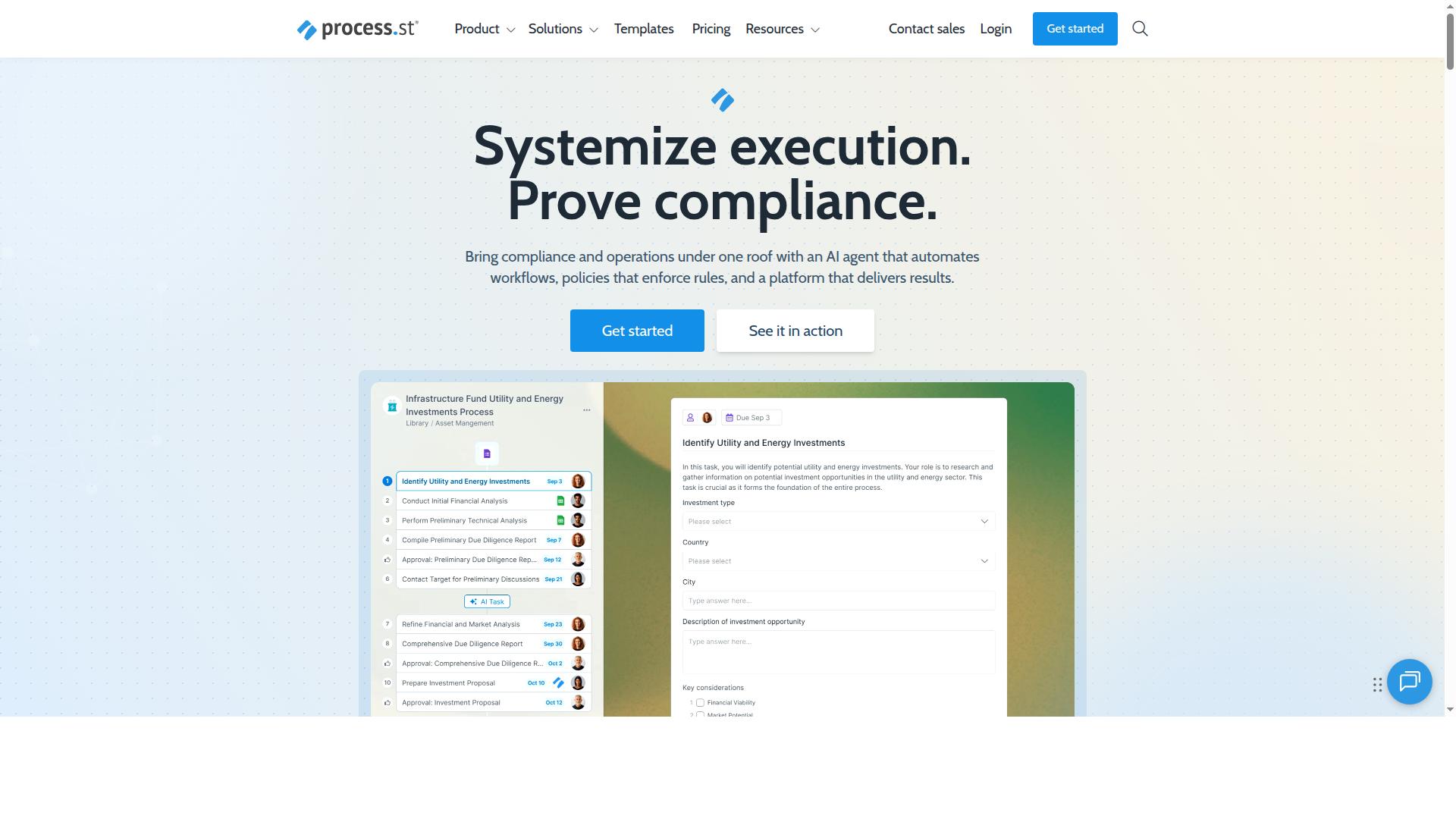
Process Street is a compliance operations platform that automates business processes, enforces policies, and delivers audit-ready proof, positioning it at the intersection of BPM and regulatory rigor. Its core promise is straightforward: turn written policies into automated workflows with governance built in, so teams do not just document how work should happen but enforce it on every run.
That framing matters in 2026, when operations leaders are under pressure to show that workflow automation is not just faster but provably compliant. A standard BPM tool helps you design and run processes. Process Street layers policy control and evidence capture on top, which is what regulators and auditors actually ask for.
The platform serves operations, compliance, HR, finance, IT, and customer management teams. It is used across industries such as financial services, healthcare, and manufacturing, where consistency of execution and a clear audit trail carry real weight.
For teams evaluating business process management software, this combination of process orchestration and governance is the differentiator. Instead of maintaining a separate policy library, a workflow engine, and an evidence folder, you get one system where the policy, the work, and the proof are connected.
Docs, Ops, and Cora: The Three Products Behind the Platform
Process Street bundles three distinct products, Docs, Ops, and Cora, each targeting a different layer of the compliance operations stack. Understanding how they split the work makes it easier to see where the platform fits into a broader operations automation strategy.
- Docs provides document management and policy control with full governance for frameworks such as ISO 9001, SOC 2, SOX, and FDA requirements.
- Ops delivers workflow automation and process orchestration, turning policies into AI-powered workflows that teams actually run.
- Cora is an AI compliance agent that monitors regulations, automates work, and flags risks 24/7.
The interconnection is the point. Docs stores the policies, Ops executes them, and Cora monitors and improves them. Each product feeds the next, so a policy change can flow into execution, and a flagged risk can circle back into the policy layer.
Around that core, the platform includes Process AI, Automations, Analytics, Apps, and Integrations. Integrations cover Zapier, Microsoft Power Automate, Tray.io, and Make, alongside Public API access, which matters for API orchestration in environments where Process Street is one part of a larger stack.
For a BPM evaluation, that structure answers a common complaint: tools that model processes well but leave compliance as an afterthought. Here, policy control, execution, and risk monitoring are separate products with a shared purpose, which is a credible foundation for intelligent automation with governance attached.
Why Process Street Is the Best BPM Tool for Automating Operations in 2026
In 2026, BPM buyers prioritize audit-ready automation and AI-assisted workflows, two areas where Process Street's compliance-first architecture gives it an edge over generic workflow tools. Three market shifts explain why this matters now.
First, compliance has become a board-level priority, with frameworks like SOC 2 and ISO 27001 shaping how operations teams design processes. Second, AI has moved from novelty to necessity in workflow engines, and buyers expect intelligent automation rather than static checklists. Third, operations teams want no-code automation they can own without waiting on IT backlogs.
Process Street addresses all three through its compliance-native design, Cora AI, and no-code workflow builder. The platform is trusted by 3,000+ companies and 1m+ users, and it holds SOC 2 Type II and ISO 27001 certifications, which gives regulated teams a credible foundation for operations automation.
From Policy to AI-Powered Workflow: How the Automation Actually Works
Process Street's automation loop starts with a policy document in Docs, converts it into a structured workflow in Ops, and then uses Cora to monitor execution and flag deviations in real time. Here is how that plays out in practice.
Take a SOC 2 access-review policy. In Docs, the policy lives as a governed document with version control and clear ownership. In Ops, that policy becomes an approval workflow: a request is submitted, a reviewer signs off, and a second approver confirms before access is granted. Each step is sequenced so the workflow engine enforces the correct order.
Human-in-the-loop checkpoints keep people in control of judgment calls. The workflow does not just run; it requires the right person to approve at the right moment, and it records who approved and when. That record becomes automated evidence capture, so audit preparation stops being a scramble through email threads and spreadsheets.
Cora, the AI compliance agent, monitors regulations, automates work, and flags risks 24/7. When an approval is skipped or a step runs out of sequence, Cora surfaces the deviation so operations can correct it before it becomes an audit finding. The result is a continuous loop: policy, workflow, monitoring, evidence.
None of this requires coding. Operations teams build and modify workflows themselves in a no-code builder, which shortens the gap between a policy change and a working process. Process Street reports a 75%+ reduction in setup time at IMCD UK, and its documentation work has helped teams standardize onboarding for 49k+ employees. For teams weighing business process management software in 2026, that combination of compliance-native design, AI monitoring, and no-code ownership is what separates a purpose-built BPM tool from a generic workflow app.
Key Features That Set Process Street Apart
Most BPM software offers a workflow builder. Far fewer pair that builder with governance controls that satisfy auditors and AI that watches execution around the clock. That combination is where Process Street separates itself from the wider field of business process management platforms.
Process Street differentiates itself through two feature clusters: compliance-grade audit trails and AI-driven workflow intelligence via Cora. One cluster proves that work happened correctly. The other catches problems before anyone has to ask.
For teams evaluating operations automation in 2026, this pairing matters. Workflow automation alone speeds up tasks. Governance and monitoring determine whether that speed survives an audit, a regulatory review, or an internal investigation. The two subsections below cover each cluster in turn.
Audit-Ready Proof and Compliance Governance
Every workflow run in Process Street generates a timestamped, immutable record, so when an auditor asks for evidence, teams can export a complete trail instead of reconstructing it from email threads. That is the core of the audit-ready proof concept: who did what, when, and under which policy version.
The two products behind this work together. Docs handles document management and policy control with full governance, including versioning and approval gates, so a policy cannot quietly change without a record. Ops turns those policies into workflows and captures execution evidence automatically as people complete tasks.
This matters because most compliance failures are documentation failures. A control may have run perfectly, but if the proof lives in a shared inbox or someone's memory, it may as well not exist. Process Street builds the evidence as a byproduct of doing the work.
The platform supports governance for ISO 9001, SOC 2, SOX, FDA, and more. Each framework demands a different flavor of evidence, from quality records to financial control testing to regulated submission trails, and the underlying record structure stays consistent across them.
A practical example shows the difference. A SOX control test that normally takes days of gathering screenshots and sign-offs can be evidenced in minutes, because the trail was written at the moment each step was completed. Teams spend their time on remediation and improvement instead of archaeology.
For operations leaders, this changes the economics of compliance. Evidence gathering stops being a periodic scramble and becomes a standing output of normal workflow automation.
AI-Powered Workflows and 24/7 Risk Monitoring with Cora
Cora, Process Street's AI layer, continuously scans workflow execution data to surface risks, such as overdue approvals, skipped steps, or unusual patterns, before they become audit findings. It is an AI compliance agent that monitors regulations, automates work, and flags risks 24/7.
The monitoring is continuous rather than periodic. Instead of a quarterly review that discovers a problem weeks after it happened, anomaly detection runs in the background and raises proactive alerts while the workflow is still active. Teams hear about drift on the day it starts.
Cora is not a standalone AI tool bolted onto a separate dashboard. It is embedded in the compliance workflow itself, which means its alerts connect to the same records that serve as audit evidence. A flag and its resolution live in one place.
That connection enables automated corrective action. When Cora detects a problem in an Ops workflow, the system can trigger a response, such as reassigning a stalled task or escalating a missing approval, rather than waiting for a manager to notice. This is what AI-powered workflows look like in practice: the process corrects itself.
This fits the broader intelligent automation trend. Hyperautomation and robotic process automation handle repetitive execution, but human-in-the-loop steps still need oversight. Cora provides that oversight layer, watching approvals, handoffs, and exceptions that pure RPA cannot judge.
The result is a workflow engine that does not just run processes but supervises them. Combined with the audit trail from Docs and Ops, it gives operations teams both a fast lane for execution and a safety net for governance, which is precisely what a 2026 BPM tool needs to deliver.
Pricing and Plans: Startup vs. Pro
Process Street offers two primary plans, Startup and Pro, with the Startup plan designed for smaller teams that still need unlimited workflows and tasks. Both tiers carry the same core promise: turning repeatable operations into structured, trackable workflows. The difference comes down to scale, automation volume, and governance depth.
Choosing between them is mostly a question of team size and automation throughput. A five-person operations team running a handful of approval workflows has very different needs from a department orchestrating dozens of automated handoffs across guests and external collaborators. The plan comparison below reflects the published limits of each tier.
| Capability | Startup | Pro |
|---|---|---|
| Workflows and tasks | Unlimited | Unlimited |
| Data Set records | Up to 5,000 | Up to 10,000 |
| Users and guests | 5 users, 10 guests | Custom users and guests |
| Automation apps | 10 | All automation apps |
| Automation actions | 100 per month | Custom volume per month |
| Public API | 50 calls per month | Custom calls per month |
The Startup plan is best understood as a simplified version of Pro. It keeps the unlimited workflow and task structure intact while capping the surrounding capacity: up to 5,000 Data Set records, 5 users, 10 guests, 10 automation apps, and 100 automation actions per month. A Public API allowance of 50 calls per month is also included.
Those limits suit a small team standardizing its first few processes. Once automation actions become a daily dependency rather than an occasional convenience, the ceiling starts to matter. A 14-day free trial on the Pro plan, with no credit card required, is the practical way to test whether your operation outgrows the Startup tier.
Pro is the full-featured tier for larger teams. It raises Data Set records to 10,000 and removes the fixed user and guest counts in favor of custom allocations. It also unlocks all automation apps and custom monthly volumes for automation actions and API calls, which matters for operations automation that runs continuously rather than in bursts.
Pro also carries the advanced compliance features that regulated or audit-heavy teams need. For organizations mapping business process management to governance requirements, that layer is often the deciding factor rather than raw capacity. Pricing for Pro is not published as a fixed figure, so the sensible step is to contact sales with your expected user count, automation volume, and compliance needs to get an accurate quote.
A simple rule of thumb: start on Startup if you are standardizing a small number of workflows with a tight team, and move to Pro when automation volume, guest collaboration, or compliance obligations start pressing against the caps. Either way, the unlimited workflow and task structure carries over, so the upgrade path does not force you to rebuild what you have already documented.
Trust Signals: Certifications, Customers, and Results
Trust in BPM software comes from two places: verifiable credentials and real-world results. Process Street backs its platform claims with third-party certifications, a customer base of 3,000+ companies and 1m+ users, and documented outcomes like 75%+ reduction in setup time reported by IMCD UK.
Those signals matter in 2026, when operations leaders must justify every platform decision to security teams and finance alike. The two sections below break down the credentials and the customer evidence in turn.
Security and Compliance Credentials
Process Street holds SOC 2 Type II and ISO 27001 certifications, two credentials that signal mature security controls and are often mandatory in enterprise BPM procurement. Each one answers a different question a buyer will face during due diligence.
SOC 2 Type II covers security, availability, and confidentiality, and it is earned over an audited period rather than a single point in time. That means an independent auditor has examined how controls actually operate day to day, not just how they are documented.
ISO 27001 is the international standard for information security management. It confirms a formal, continuously maintained system for protecting information, which global teams often require before rolling out workflow automation across departments.
Beyond those two, Process Street is HIPAA compliant with a BAA available upon request, and also GDPR and CCPA compliant, with AWS CIS compliance noted as well. For teams handling regulated data, these frameworks turn a security review into a checklist rather than a blocker.
Data residency is another differentiator. Process Street offers options across the US, UK, Canada, EU, Australia, and UAE, which matters for global organizations whose regional rules dictate where operational data can live. The platform also states that customer data is never used to train AI models, a relevant assurance as intelligent automation and AI-assisted workflows become standard in operations.
Customer Testimonials and Measurable Outcomes
Process Street's customer stories include named testimonials from Salesforce, Colliers, and HEALTHeLINK™, alongside metrics like 49k+ employees standardized on onboarding and 30% faster documentation. These are verifiable, named references, not anonymous reviews, which makes them far more useful when building an internal business case.
Alex Hauer, Senior Success Consultant at Salesforce, speaks to onboarding standardization at scale, the outcome behind that 49k+ employee figure. For large organizations, consistent onboarding across thousands of hires is exactly the kind of process orchestration challenge BPM software exists to solve.
Linda White, Head of Technology Services at Colliers, represents the documentation side of the story, where teams report documentation completed 30% faster. Diane Guy, Operations Systems Manager at HEALTHeLINK™, adds a healthcare operations perspective, a sector where compliance and auditability weigh heavily on tool selection.
On measurable setup gains, Pete Watts, IT Manager at IMCD UK, is tied to the headline 75%+ reduction in setup time. Joshua Ketter, Global CEO at Spreetail, rounds out the leadership-level references. Additional named voices include John Krienke of Internet2, Dr. Adeyemi Adeyinka of Avon Healthcare, Patty Scharf of Acuity, Emilee Sheehy of Zonos, and Chelsea Lynch of Bentobox.
Customers also include organizations such as Elite Business Ventures, the Government of Canada, and Hustle Fund, spanning commercial, public sector, and investment contexts. Alongside a 98% customer rating and a 5 minute average response time, the picture is consistent: named customers, documented outcomes, and support metrics that hold up to scrutiny.
Who Should Use Process Street for Operations Automation
Process Street fits teams that own recurring, compliance-sensitive processes, especially in operations, compliance, HR, finance, and IT security, across industries like financial services, healthcare, and manufacturing. These are the groups where a missed step carries real cost, and where workflow automation turns tribal knowledge into a repeatable system.
The common thread is not company size. It is process repetition and accountability. If a team runs the same workflow every week and needs proof it was followed, Process Street is built for that job.
Below are the teams and industries where it lands best, with a one-line use case for each.
| Team | Typical Use Case |
|---|---|
| Operations | Runs custom workflows for recurring operational tasks so nothing falls through the cracks |
| Customer management | Standardizes client onboarding so every new account follows the same steps |
| Compliance | Uses document control and ISO compliance workflows to keep policies current and auditable |
| Human resources | Automates employee onboarding from offer acceptance to first-week checklists |
| Finance | Relies on structured records and approval workflows to support audit readiness |
| IT and security | Documents and enforces repeatable controls across access and change processes |
Industry matters too. Financial services and capital markets teams lean on process discipline for regulatory work. Healthcare and manufacturing teams use quality tracking to keep standards consistent. Real estate and property management teams apply the same logic to client and tenant workflows. Professional services and technology teams use it to keep delivery and internal operations predictable.
Across all of these, the value is the same: process orchestration with a clear record of who did what and when. That record is what makes no-code automation useful to a compliance-minded team, not just a convenience.
Who should not use it? Two groups stand out. Very small teams with no compliance or audit needs may find a lighter task manager is enough. And teams looking for a pure RPA tool to script screen-level bot actions should look elsewhere, since Process Street is built around human-in-the-loop workflows and structured process records rather than robotic desktop automation.
If your team runs recurring, accountable processes and needs them documented, assigned, and traceable, Process Street is a strong fit.
Final Verdict: Is Process Street the Right BPM Tool for Your Team in 2026?
Process Street earns a strong recommendation for teams that need BPM with compliance built in, but it may be overkill for simple, non-regulated workflows. The platform is designed for organizations where operations automation must also produce defensible proof that every step happened, in order, with the right approvals attached.
That makes it a natural fit for compliance-heavy operations in regulated industries such as finance, healthcare, manufacturing, and professional services. If your team answers to auditors, regulators, or internal risk committees, the value of audit-ready records is immediate and ongoing.
Teams looking for a lightweight task manager will likely find more than they need here. The same applies to organizations seeking pure robotic process automation or RPA to move data between systems without human involvement. Process Street is built around structured, repeatable processes with people in the loop, not unattended bots.
Where the platform stands apart is the combination of capabilities that support that model. Four differentiators matter most when comparing BPM software options for 2026:
- Audit-ready proof: every workflow run leaves a traceable record, which is central to compliance reporting.
- Cora AI: an AI layer that supports how teams build and run their processes.
- Certifications: formal recognition that supports security and compliance conversations with stakeholders.
- Named customers: publicly referenced organizations that validate the platform in real operating environments.
For teams weighing digital transformation budgets, the practical question is whether the workflow needs to be provable, not just completed. When the answer is yes, the platform's strength in approval workflows and human-in-the-loop process orchestration becomes a clear advantage over general-purpose task tools.
If your processes are informal and low-risk, a simpler tool may serve you well. But if your operations automation must survive scrutiny from auditors, regulators, or enterprise buyers, Process Street is built for exactly that requirement.
The clearest next step is to talk to the team directly. Sales contact is available for a demo or a pricing discussion, so you can map the platform against your specific compliance and workflow needs before committing.
Ongoing help is equally accessible. Support runs through email and chat, with a 5 minutes average response time and a 98% customer rating, which matters when a workflow stalls and a team needs answers quickly.
You can also follow the brand through its social profiles and its AWS Marketplace listing, both of which offer additional channels for updates, evaluation, and procurement. Taken together, the product depth, the compliance focus, and the responsive support make Process Street a confident choice for regulated operations in 2026.
Frequently Asked Questions
What makes Process Street a strong choice for automating operations in 2026?
Process Street is a compliance operations platform that combines workflow automation, document management, and audit-ready proof in one place. Its Ops product turns policies into AI-powered workflows, while Docs provides document management and policy control with governance for standards like ISO 9001, SOC 2, SOX, and FDA. This makes it a good fit for operations teams that need automation and compliance together rather than as separate tools.
How is Process Street different from a general-purpose BPM tool?
Rather than only mapping and modeling processes, Process Street focuses on enforcing them-automating business processes, enforcing policies, and delivering audit-ready proof. Its three products (Docs, Ops, and Cora) cover document governance, workflow automation, and AI compliance support. Teams in operations, compliance, HR, finance, and IT can standardize how work gets done while keeping evidence for audits.
Which teams and industries is Process Street best suited for?
Process Street is built for teams in Operations, Customer management, Compliance, Human resources, Finance, and IT & security. It serves industries including financial services, real estate, manufacturing, healthcare, professional services, technology, and capital markets. It's trusted by 3,000+ companies and 1m+ users, with 49k+ employees standardized on its onboarding workflows.
What plans does Process Street offer?
Process Street offers three plans: Startup, a simplified Pro plan for startups with unlimited workflows and tasks, up to 5,000 Data Set records, 5 users, 10 guests, 10 automation apps, 100 automation actions/month, and Public API access. Contact sales for details on the other plans and to find the right fit for your team size and automation needs.
Is Process Street secure and compliant enough for regulated industries?
Yes-Process Street is SOC 2 Type II certified, ISO 27001 certified, and HIPAA compliant. It also offers data residency options in the US, UK, Canada, EU, Australia, and UAE regions. For teams in financial services, healthcare, and other regulated sectors, this means automation can run on a platform built with governance in mind.
How quickly can teams get up and running, and what support is available?
Customers report fast results: IMCD UK reported a 75%+ reduction in setup time, and users see 30% faster documentation. Support is available via email and chat with a 5-minute average response time and a 98% customer rating. You can also reach out to sales to discuss your specific operations and compliance requirements.